 Adam Haroon
Perception Reliability · Diagnose → Repair
Shape-Prior Shortcuts & PhiCalNet
A model that's right for the wrong reason: diagnosing a hidden shortcut in learned FPP, then repairing it with differentiable physics.
Abstract
Symptom: a long-range single-shot FPP network posts strong benchmark numbers that don't survive a distribution shift. Diagnosis: the network learned to lean on a spurious shape prior, a regularity of the training objects, instead of the actual fringe signal. High scores, hollow understanding: the classic shortcut-learning failure, appearing in optical metrology.
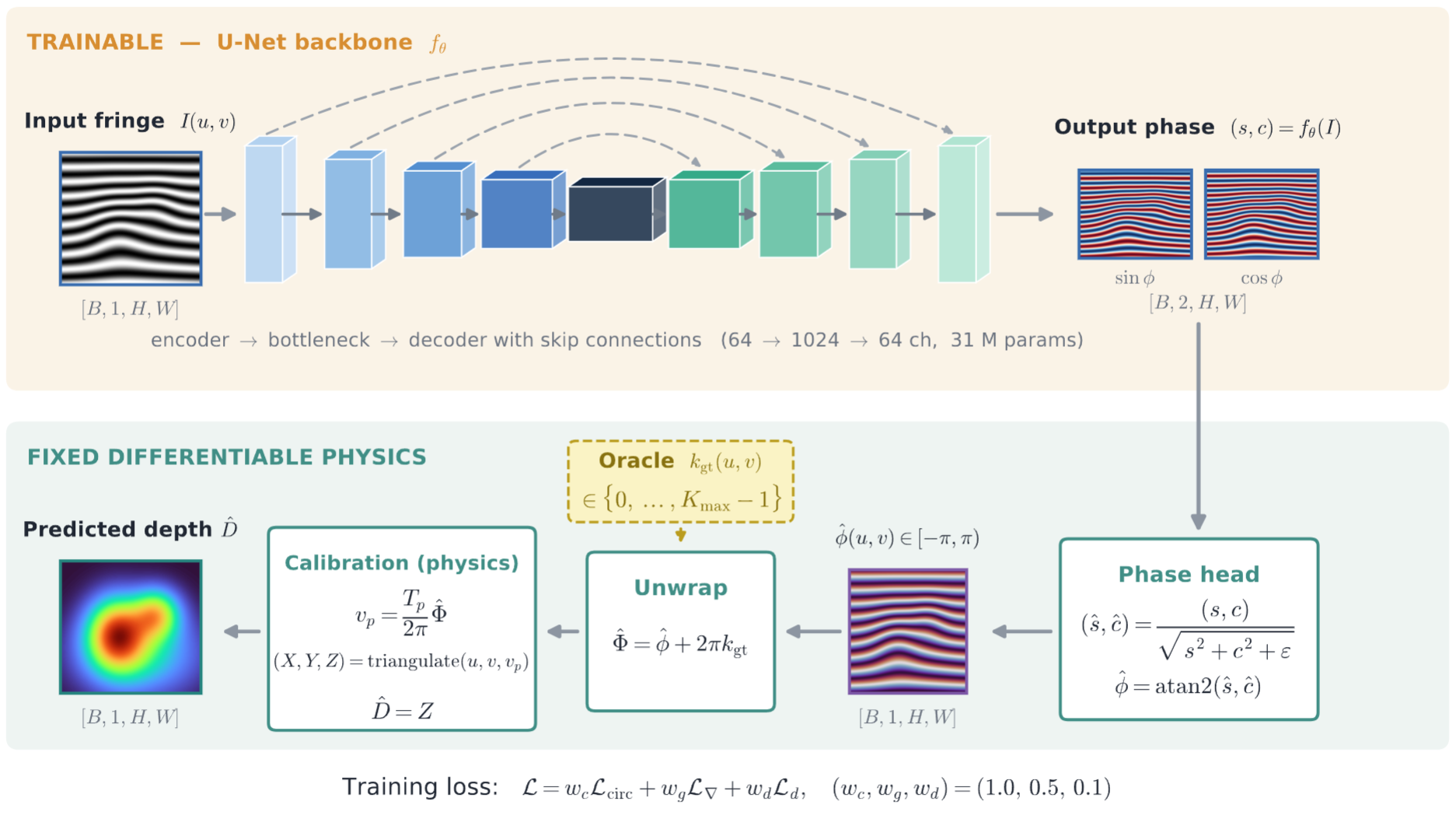
Repair: PhiCalNet rebuilds the FPP physics into the learning pipeline. A trainable U-Net backbone predicts only the wrapped phase; unwrapping, calibration, and triangulation to depth remain fixed differentiable physics. The model is forced to solve the problem from the signal, because the physics leaves it nowhere to hide a shortcut.
The two-paper series (diagnosis, then repair) is a template for the broader thesis: learned perception components inherit every failure mode of learned models, and physics-based structure is how you take those failure modes away.